Local News
Why early voting is safe in Georgia
DeKalb’s scanner-to-tally process can be watched, and early voting runs Oct. 13–30 at 22 sites including three around Lithonia.
By Staff · October 17, 2026
The national rumor is that a mark a poll worker writes on a ballot gets that ballot thrown out. Election officials in multiple states have called the claim false: the markings are administrative and do not by themselves invalidate a ballot. Fact-checkers at Snopes found no evidence that poll-worker markings generally disqualify ballots; a ballot only runs into trouble when markings make a voter's selections unreadable or the ballot violates the rules. Georgia Secretary of State Brad Raffensperger went further: "We have the most secure election process in the country."
But a DeKalb County neighbor doesn't have to take anyone's assurance on faith. The county's process — from the scanner to the tally — can be watched.
Where and when to vote early in DeKalb
DeKalb County is running 22 early-voting locations for the November 3, 2026 general election, expanded from 20 by the county election board. In-person early voting runs Tuesday, October 13 through Friday, October 30, 2026.
Hours:
- 7 a.m. to 7 p.m. Monday through Friday (October 13–30)
- 9 a.m. to 6 p.m. Saturdays, October 17 and 24
- Noon to 6 p.m. Sundays, October 18 and 25
Around Lithonia:
- New Bethel A.M.E. Church, 8350 Rockbridge Road
- Redan-Trotti Library, 1569 Wellborn Road
- Salem-Panola Library, 5137 Salem Road
A registered DeKalb County voter may vote early at any early-voting location in the county, not only their assigned Election Day precinct. Bring an acceptable photo ID — a Georgia driver's license, U.S. passport, or Georgia voter identification card. The registration deadline for the November election was October 5, 2026. For locations, schedules, wait times, or absentee-ballot questions, call DeKalb Voter Registration and Elections at 404-298-4020.
Demand is real: more than 188,600 Georgians cast ballots on the first day of early voting, October 13, 2026 — a midterm first-day record and more than 53,000 above the comparable first day in 2022 (134,962). In DeKalb County, voters stood in long lines outside the Voter Registration and Elections Office. The Salem-Panola Library is also one of the DeKalb early-voting locations that hosts a ballot drop box.
What happens the moment you submit your ballot
A Georgia voter marks their choices on a ballot-marking device, which prints out a paper ballot, then inserts the paper ballot into a precinct scanner, which scans it and drops it into a locked ballot box. The Secretary of State's office says a voter can know their in-person ballot was accepted the moment the scanner takes it, with an on-screen confirmation that it was successfully cast — the exact wording can vary by machine. A voter is recorded as having voted when they check in at the poll pad before receiving a ballot; that check-in is what prevents a second ballot in the same election. The scanner tallies the anonymous paper ballot, but it does not store the voter's identity or update their voter record.
Where the ballot sits until Election Day
At the end of each early-voting day, ballots stay in the locked ballot boxes of the scanners, and the equipment is secured overnight; the scanners' memory cards remain in the machines while advance voting is underway. If a ballot box holds more than 1,500 ballots at closing, the registrar and two sworn witnesses move the ballots into durable, sealed, sealable containers, sign them, then reseal the ballot box and record the new seal numbers.
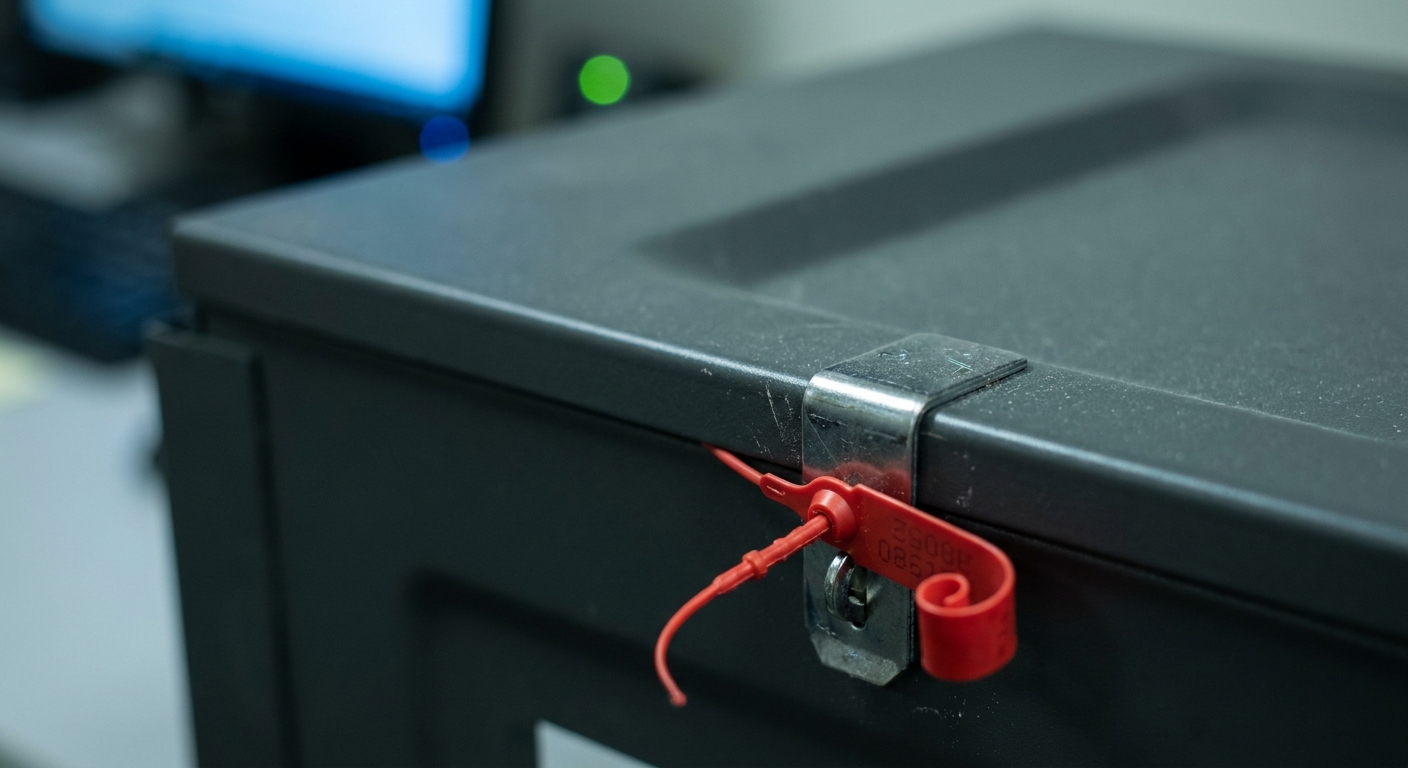
When ballots do move, it happens under chain of custody: the registrar and at least one sworn witness deliver the sealed ballot container to the election superintendent for secure storage and complete a chain-of-custody form. Before voting resumes the next morning, those seal numbers are checked for tampering. The ballot-marking devices themselves are secured with numbered plastic seals, so any tampering would be detectable before and during use.
Political parties, political bodies, and candidates may place poll watchers who can observe advance voting — including the counting and recording of votes — though watchers may not interfere with the process or handle ballots.
When your early vote is counted and checked
Georgia law requires advance-voting results to be tabulated and reported by 8 p.m. on Election Day, or within one hour after all county polls close, whichever is later. After the polls close on Election Day, election officials verify the scanner seals, open the sealed materials, remove the memory cards and results tapes, and transfer the early-vote totals into the county election-management system to be consolidated into results.
Then comes the hand-check: Georgia requires a statewide risk-limiting audit after the November 2026 general election and before certification, in which each county hand-inspects a random sample of paper ballots and compares them to the machine totals to verify the outcome. DeKalb County's election page lists the same post-election steps — computation and canvassing, ballot processing, and the risk-limiting audit — before results are finalized.
An early ballot is cast the instant it's scanned, then held locked, sealed, and watched until the official tally. The voter knows before Election Day that their vote is already in — rather than betting on showing up amid lines, weather, or last-minute surprises. Raffensperger put his stake in it plainly: "My job isn't to make sure that the Republicans win or the Democrats win. My job is to make sure the winner wins."
Keisha L. Smith, Executive Director of DeKalb County Voter Registration and Elections, said, "Our approach is to meet voters where they are and make trusted election information easy to find, understand and act on." The county election board and its elections staff run every step of that sealed, watched chain — from the locked scanner to the audit — so a neighbor's early vote never passes through a single unchecked set of hands.